

Date to be announced
Contact us for more infoTRAINING TIMES
Learn how to apply ICH Q2(R2), Q14, and USP; guidelines to support method suitability throughout its lifecycle, aligned with regulatory and compendial requirements.
Explore a structured approach to writing validation and transfer protocols, reducing variability and documentation mistakes that can cause compliance issues.
Use ATPs and Analytical Control Strategies (ACS) to set meaningful acceptance criteria, build in robustness, and support reliable method transfer across sites.
Ensure methods meet FDA and EMA expectations, support post-approval changes, and help avoid revalidation, transfer delays, or regulatory rejections.
Three days of expert-led Zoom sessions packed with discussions, Q&As, and real-world scenarios.
All slides, tools, and supporting materials available in one place - before, during, and after the course.
Receive a digital certificate (also LinkedIn-ready) that verifies your skills in strategic trial planning.

Learn how to apply the principles of QbD, ATP, and ACS from development through validation, transfer, and routine use.
Gain hands-on insight into the updated guidances and how to design protocols, define acceptance criteria, and document outcomes effectively.
Link acceptance criteria to method purpose, reduce variability, and demonstrate stability-indicating capability and robustness.
Identify common errors in test method documentation and understand how to use risk-based approaches to support knowledge management.
Ensure successful method transfers across sites and implement sound change control strategies that support ongoing regulatory expectations.
Designed for professionals who want to enhance their expertise and advance their careers

Mark Powell Scientific Limited, UK, Director
Dr Mark Powell a Fellow of the Royal Society of Chemistry (RSC) with over thirty years’ experience as a senior analytical chemist. Mark has served as both Honorary Secretary and Honorary Treasurer of the RSC’s Analytical Division and led a working group on continuing professional development until July 2016. He has worked at a senior level in several companies with responsibility for analytical development and equipment qualification. In 2010 Mark was appointed Scientific Manager of a UK-based pharmaceutical CRO, with responsibility for guiding the direction of drug development programmes as well as establishing collaborations with academia and instrument manufacturers. In 2013, he set up his own company to provide training and consultancy services to the pharmaceutical industry. His consultancy work has involved, amongst other things, managing the analytical aspects of pharmaceutical development programmes and conducting data integrity audits. He is in demand as a trainer in topics such as pharmaceutical development, chromatography, spectroscopy, dissolution testing, data integrity, control of impurities, technical writing, and stability/stress studies.
Learn More →

Take a sneak peek at the trainer's presentation.
View PDF →
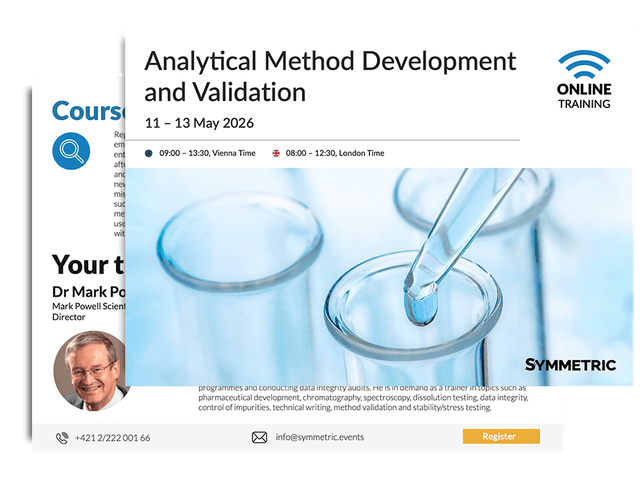
Download the full training agenda to reveal complete session details, training takeaways, case studies, daily schedule, special features and full trainer bio.
“The in-house training was very detailed and well received by our participants. We received very positive feedback from the team, and the session delivered strong value for our organisation.”Darren McConnon